SnapAzule — $0+ firmware Download firmware
Free download — $0 minimum
Choose any amount
Optional support for the project
No fixed price
Hardware + software for 3D printing

Turn events from your 3D printer into intelligent actions.

SnapAzule watches your print, detects important events and connects the printer to devices and automations. Monitor layers, trigger Bluetooth commands, record what happened and follow everything through a local interface. Experimental features and new synchronization techniques are presented openly in the SnapAzule Lab.

Product in development · Real tests · Documented limitations
LAYER 42 DETECTED
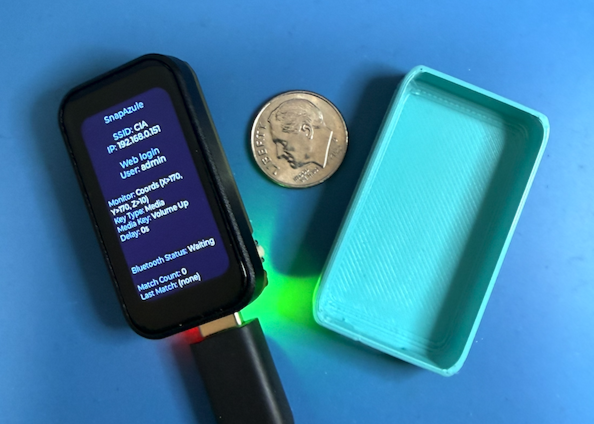
SnapAzule touch device on a blue surface
MONITORING · LOCAL
EVENT ACTIONBLE HID / SHUTTERFRAME SAVED ✓
What the product does

Observe. Automate. Understand.

SnapAzule turns 3D printing events into Bluetooth actions and useful data for following and diagnosing the whole process.

01 / Capture

Capture

Trigger capture actions on a phone during layer changes, pauses and specific print events.

EVENT → BLE HID
The connected app captures and saves the image.
02 / Monitor

Monitor

Follow the current layer, connections, active mode, events and print state on the touch screen and local web panel.

MQTT ONLINE · LAYER 042
BLE CONNECTED · diagnostic state

03 / Automate

Automate

Turn MQTT, G-code, coordinates and pauses into Bluetooth HID commands for compatible phones, computers and software.

MQTT · G-CODE · XYZ → BLE
The target must accept the configured shortcut.

04 / Analyze

Analyze

Inspect latency, reconnects, duplicates, losses, queues and failures to understand how the system behaved.

MQTT_RX · QUEUE_IN · BLE_RESULT
LATENCY · failure traces

Physical synchronization, IMU, vibration, Digital Twin and Precision Pause remain under research and validation in the SnapAzule Lab.

Compatibility, stated carefully

Expand compatibility gradually and transparently.

We publish what has been tested, what is currently being validated and what still needs evidence. SnapAzule is not presented as compatible with every printer or phone.

Tested starting point

Tested

The Bambu A1 is the initial printer platform used for the main timelapse workflow and first validation runs.

  • ✓ Bambu MQTT local flow
  • ✓ iPhone camera via BLE HID
  • ✓ SnapAzule ESP32-S3 Touch

In validation

Beta

These paths are being tested model by model. Results can change with firmware, profiles and the exact event sequence.

  • → Prusa Link via HTTP/API
  • → Coordinate and incremental modes
  • → Android shutter compatibility

Not validated yet

Open

Other printers, phones and software may work, but they are not declared compatible until we have repeatable evidence.

  • — No universal printer claim
  • — No universal phone claim
  • — Test results are published by setup
Compatibility policy: support expands one tested setup at a time. If your printer or phone is not listed, contact us with the model and workflow so it can become a real test case.
Much more than timelapse

One print event.
A whole set of useful actions.

The same touch controller that triggers a camera can also act as a local dashboard, Bluetooth remote, flight recorder and gateway for your own workflows.

01 / Control

Program any BLE action

Send Volume +/−, Play/Pause, Mute, Enter, Space or a custom keycode to a phone, computer, OBS or another shortcut-driven tool.

02 / Observe

Use it as a printer panel

Keep the active mode, layer, connection state and latest event visible on the local touch screen while the printer works.

03 / Record

Keep a flight recorder

Save reconnects, raw MQTT events, queue depth, latency, BLE results and failures to CSV or JSONL on the SD card.

04 / Document

Capture important moments

Photograph a specific layer, height, coordinate, pause, start or finish to document how a part was made.

05 / Integrate

Connect local workflows

Turn MQTT, HTTP or G-code events into actions for scripts, media software and other systems on your local network.

06 / Lab

Research motion and vibration

Use the integrated IMU to study park, movement, impact and abnormal patterns. This remains experimental research.

SnapAzule Lab · experimental

Research belongs in the open.

Where we test new ways to observe, synchronize and automate 3D printers. Real experiments, open results and documented limitations. Research technologies are not presented as ready features until they are validated.

Idea Prototype In testing Partial result Lab validated Not recommended yet
Experiment 01In testing

IMU and vibration

Objective:
detect movement, vibration and head stabilization.
Hypothesis:
the QMI8658 can expose a usable settle signal.
Setup:
ESP32-S3 Touch, QMI8658 and a Bambu A1.
Result:
partial traces; no stable threshold yet.
Failures:
printer profiles and mounting change the signal.
Next:
compare vibration windows across repeated parks.
Experiment 02Prototype

Physical park detection

Objective:
confirm when the head reaches the correct position.
Hypothesis:
MQTT state alone cannot prove physical position.
Setup:
MQTT event, post-park profile and IMU shadow mode.
Result:
logical confirmation works; physical confirmation remains open.
Failures:
a fast or altered park can create a false positive.
Next:
combine motion traces with repeatable A1 tests.
Experiment 03Partial result

Precision Pause

Objective:
pause, confirm stop, capture and resume the print.
Hypothesis:
a settle window improves frame consistency.
Setup:
Bambu MQTT, BLE shutter, settle timer and iPhone.
Result:
works on selected profiles, but adds print time.
Failures:
MQTT state does not guarantee exact physical position.
Next:
test MQTT plus visual or vibration confirmation.
Experiment 04Idea

Adaptive synchronization

Objective:
adjust the trigger moment using live timing signals.
Hypothesis:
latency history can improve timing without a fixed delay.
Setup:
MQTT timestamps, BLE results, motion and print history.
Result:
not measured as a repeatable method yet.
Failures:
network and printer behavior vary between runs.
Next:
define a benchmark and collect a larger test set.
Experiment 05Prototype

Digital Twin via FTPS

Objective:
estimate the time from layer change to capture from real G-code.
Hypothesis:
file context can provide a useful temporal model.
Setup:
FTPS file read, G-code parser and local event log.
Result:
experimental; not a production integration.
Failures:
resource contention can affect MQTT and timing.
Next:
measure the trade-off before recommending the path.
Experiment 06In testing

Mechanical behavior

Objective:
investigate acceleration, resonance, blur and print behavior.
Hypothesis:
vibration patterns can explain inconsistent frames.
Setup:
IMU traces, continuous video and saved frames.
Result:
evidence collection in progress.
Failures:
mounting, lighting and camera exposure also matter.
Next:
publish paired traces, frames and test conditions.
Evidence, not just claims

Test videos should include the misses too.

The Lab is designed to publish continuous footage and comparisons: correct captures, motion blur, BLE delay, MQTT reconnects, synchronization failures and before/after changes.

Correct capture
real footage slot
Head still moving
failure case
BLE delay / reconnect
diagnostic case
Before / after change
comparison case
Lab disclaimer: The resources shown in SnapAzule Lab are experimental. They may change, fail or be unavailable in the stable product release. A Lab result is not a product guarantee.
How it works

Plug in. Pair. Print. That's it.

01

License & flash in the browser

Plug the SnapAzule into any computer, open shop.snapazule.com in Chrome or Edge, and click Flash. About 30 seconds.

02

Pair with your camera

BLE‑HID targets can include an iPhone camera, a DSLR app, an OBS hotkey or a laptop — when the specific setup accepts the configured key. Compatibility is validated per model.

03

Pick a trigger

Choose a tile on the touch screen — G‑code, layer, coordinate, incremental — and press Start. SnapAzule takes it from there.

Honest about scope

SnapAzule doesn't take photos.
It sends keystrokes.

Point the keystroke at whatever app actually presses the shutter — iPhone Camera, a DSLR tether, an OBS hotkey, a macro recorder on your laptop. SnapAzule is the trigger; you pick the camera.

Ready?

The ultimate software remote!

Free download with a $0 minimum · contribute any amount if you want to support the project

Download firmware — $0+